
News
Jul. 16, 2026
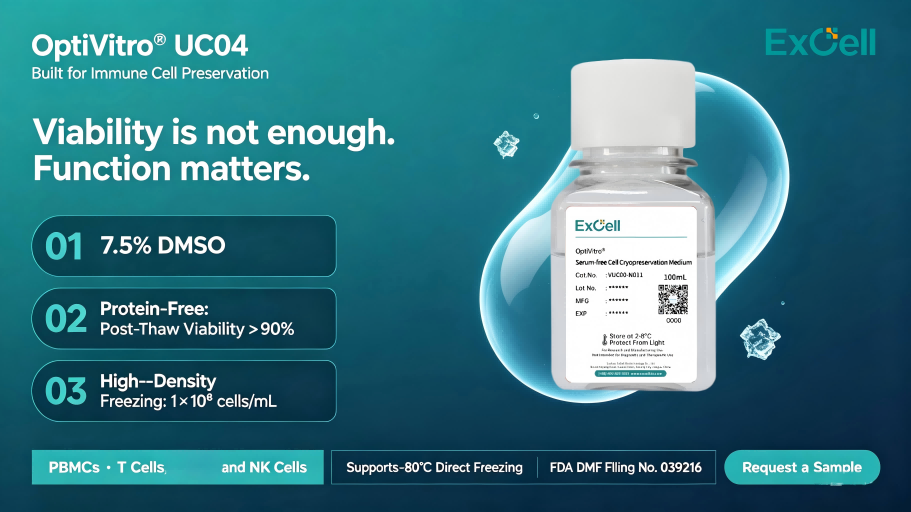
One Solution, One Standard: OptiVitro® UC04 – Redefining Immune Cell Cryopreservation
Introduction
When it comes to immune cell cryopreservation, there is no room for compromise. T cells, NK cells, and PBMCs are not just ordinary cell types—they are living tools of precision medicine. Their post-thaw functional integrity directly determines the success of research outcomes and therapeutic applications.
That is precisely why we developed OptiVitro® UC04—a serum-free, protein-free cryopreservation medium purpose-built for immune cells. It is not a modified version of a general-purpose product, but a dedicated solution engineered for one of the most demanding applications in cell biology today
The Challenge: Immune Cells Are Different
Conventional cryopreservation media are typically designed for stable cell lines, relying on 10% DMSO and animal-derived components. They may keep cells "alive," but for immune cells, viability does not equal functionality.
Post-thaw immune cells often suffer from:
l Reduced proliferation capacity
l Impaired cytotoxic activity
l Increased apoptosis induced by DMSO toxicity
When the endpoint of your experiment is functional recovery rather than mere membrane integrity, a "one-size-fits-all" approach simply falls short
The Solution: Designed for Immune Cells, Backed by Data
OptiVitro® UC04 is not a repurposed universal medium—it is built from the ground up specifically for immune cell preservation.
Key Differentiators:
l Reduced DMSO (7.5%) – Minimizes cytotoxicity while maintaining cryoprotective efficiency, particularly critical for sensitive immune subsets;
l Protein-free, chemically defined formulation – Eliminates the risk of xeno-contamination and batch-to-batch variability, ensuring reproducibility across experiments and scale-up production;
l Comprehensively validated in PBMCs, T cells, and NK cells – Consistently achieves post-thaw viability above 90%, with preserved phenotype and effector function;
l Supports non-programmed freezing – Eliminates the need for expensive controlled-rate freezing equipment; cells can be placed directly into a -80°C freezer, simplifying workflows and lowering entry barriers;
l FDA DMF filing (No. 039216) – Provides regulatory support for drug development and clinical translation, accelerating your IND-enabling studie
Performance That Speaks for Itself
Every feature of UC04 is backed by rigorous validation. The following data are derived from independent studies designed to reflect real-world applications:
PBMC → T Cell Activation: Sustained Proliferation Post-Thaw
PBMCs were cryopreserved in liquid nitrogen (>72 hours), thawed, seeded at 8×10⁶ cells, and activated into T cells with continuous culture through Day 5. UC04-preserved cells not only maintained high viability immediately post-thaw, but also demonstrated robust proliferation kinetics at D3 and D5—proof that cryopreservation does not compromise their expansion potential (Figure A).

Donor-to-Donor Consistency
Donor variability is a major challenge in immune cell research. UC04 delivers consistent post-thaw viability (>90%) across PBMCs from multiple donors, demonstrating its robustness and broad compatibility with diverse individual samples (Figure B).

High-Density Cryopreservation Without Compromise
In immune cell therapy, high-density freezing is a routine requirement. UC04 supports T cells and NK cells cryopreserved at 1×10⁸ cells/mL in liquid nitrogen for over 72 hours, with viability consistently maintained at high levels at 0h, 24h, and 48h post-thaw—proving reliable protection even under extreme cell density conditions.


These are not just numbers—they are indicators of biological relevance. When your experiments depend on cell behavior rather than cell count alone, UC04 delivers the confidence you need.
Why UC04 Stands Alone
UC04 is precisely positioned and rigorously tested, optimized around a single objective: keeping immune cells as close to their native state as possible after cryopreservation.
For researchers working on CAR-T, NK-based therapies, or immune profiling studies, this focus translates into fewer variables, less time spent on optimization, and more trustworthy data.
More importantly, the DMF filing means UC04 is more than a research-grade reagent—it is a compliance-ready product with clinical translation potential. From benchtop to regulatory filing, you can maintain the same cryopreservation workflow without switching products.
Conclusion: Choose What Matches Your Cells' True Needs
Not every cryopreservation medium needs to do everything. But when your work involves immune cells—for the sake of your research, and ultimately for patients—you owe it to yourself to use a medium that truly understands their uniqueness.
OptiVitro® UC04 is that answer.

Want to see the difference in your post-thaw immune cell function firsthand? Contact us to request a sample.Contact ExCell Bio Group | Global Life Science Reagents Biopharmaceuticals
Our Products

FBS is the most commonly used natural medium in cell cultures

